Can Dogs Eat Onions? Why the Answer Is Simply No
Medically reviewed by Roger Clemmons, DVM, PhD, DACVIM (Neurology and Neurosurgery), CVA, CVFT — For general education — not a substitute for veterinary care.
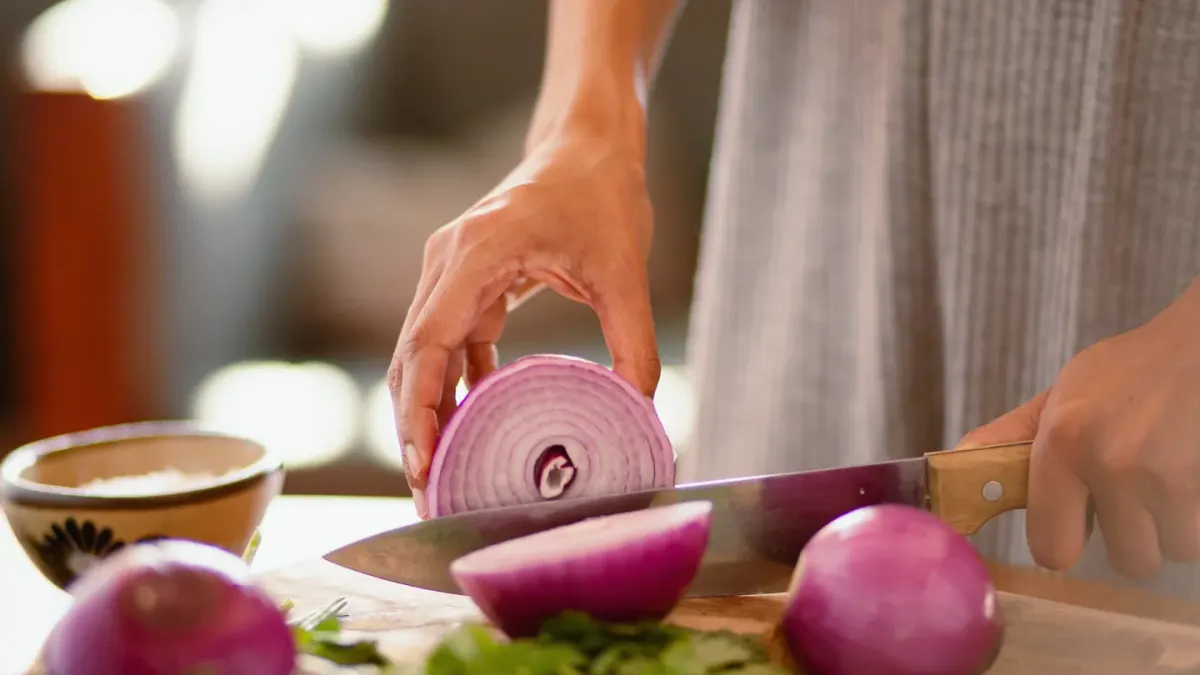
No — onions in any form, raw, cooked, or powdered, damage a dog's red blood cells and cause real anemia.
On this page
The gravy boat had been sitting on the counter for maybe ninety seconds when I heard the crash. A retriever named Otis — not a patient of mine, just a dog I was watching for a friend over a holiday visit — had gotten his front paws up on the counter’s edge and tipped the whole thing. Most of it went on the floor. Some of it, unmistakably, went into his mouth before anyone could get to him. The gravy had been built on a base of sautéed onion and a splash of garlic, reduced down to something thick and concentrated. My friend’s first instinct was to laugh it off — dogs get into things, this is what dogs do. My first instinct was to ask exactly how much onion had gone into that pan, because the answer to that question determines whether the next few hours are uneventful or an emergency room visit.
What thiosulfates actually do to a red blood cell
Here is the mechanism, because it matters for how seriously you take this. Onions and their relatives — garlic, leeks, chives, shallots — contain organosulfur compounds, most notably thiosulfates, that dogs cannot metabolize the way humans can. Once absorbed, these compounds oxidize hemoglobin inside the red blood cell. The damaged hemoglobin denatures and clumps into structures called Heinz bodies, which the spleen recognizes as abnormal and starts pulling out of circulation. Enough Heinz bodies, and you get a genuine hemolytic anemia — a falling red cell count from cells being destroyed faster than the bone marrow can replace them. According to the Merck Veterinary Manual, Heinz bodies and elevated methemoglobin can show up within 24 hours of ingestion, even though visible signs of anemia may take several days longer to appear.
Why “just a little” doesn’t hold up
Owners often ask me to draw a safe line — a teaspoon, a bite, a lick off a plate. I don’t think that line exists in any useful clinical sense. Clinical toxicity in dogs has been documented at roughly 15 to 30 grams of raw onion per kilogram of body weight, but that range assumes raw onion. Cooking concentrates flavor without destroying the thiosulfates, and powdered or dehydrated onion is dramatically more concentrated by weight than the fresh vegetable, so a small spoonful of seasoning can deliver more toxic load than a much larger amount of raw onion would. The ASPCA lists onion among plants toxic to pets specifically because of this hemolytic anemia risk, and its poison-control listing doesn’t carve out an exception for cooked or minimal amounts. When a food’s toxic threshold shifts that much depending on preparation, the honest, evidence-anchored answer is to stop trying to calculate a safe dose and just keep the ingredient out of the bowl entirely.

The garlic counterargument — and why I still say no
I practice with one foot in Western neurology and one in traditional Chinese veterinary medicine, and I’ll be direct about the strongest objection I hear to a blanket onion-and-garlic ban: TCVM food therapy has historically used small amounts of garlic for its warming, parasite-repelling properties, and some integrative practitioners still reach for it in tiny, controlled doses under close supervision. I understand the appeal of a tradition that treats food as medicine. But that framework was built around dosing decisions made by a trained practitioner monitoring an individual patient over time, not a spoonful dropped into a bowl at home. Garlic is three to five times more potent than onion gram for gram, and the margin between a traditionally described therapeutic dose and a hemolytic one is not something I’m willing to bet a patient’s red blood cell count on without direct oversight. Reach for the imaging study and the acupuncture needle both, by all means — but reach for them together, deliberately, not as a justification for casual kitchen exposure.
Why the delay fools owners
A stir-fry bag, left within nose range on a counter, is a scenario I hear about often enough that it’s worth walking through. Say a dog gets into one — onions, garlic, a little soy sauce, maybe some scallion. The dog vomits once that evening, seems fine by morning, and eats breakfast normally. Three days later, the dog is quieter than usual, gums look a shade paler, and urine in the yard has darkened. That gap is the trap. Early gastrointestinal upset from onion ingestion often resolves within a day, and dogs frequently look completely normal through the early phase of red-cell damage happening underneath, which is exactly why the decision point isn’t “does my dog seem sick,” it’s “did my dog eat onion, in any amount, in any form.”
What a vet visit actually involves
If ingestion happened recently, your veterinarian may induce vomiting or use activated charcoal to limit further absorption. Beyond that early window, monitoring shifts to bloodwork — checking for Heinz bodies on a smear, tracking red cell counts and methemoglobin over several days — because the anemia can still develop even after the stomach has settled. Supportive care in more significant cases includes IV fluids and, rarely, a blood transfusion. None of this is guesswork; it’s the same oxidative-injury logic that explains the initial exposure, just running in reverse.
If your dog’s stomach is unsettled in the aftermath — even from a milder exposure that didn’t warrant emergency treatment — many vets recommend a short bland-diet period, and some clients ask about probiotic supplements to help things along. I’d rather be honest than reassuring here: the evidence on probiotics for canine GI upset is genuinely mixed. A 2025 randomized trial found that gut microbiome Frontiers in Veterinary Science: diversity metrics did not distinguish non-responders from responders, meaning a dog’s baseline gut diversity didn’t predict whether a probiotic helped. That’s a reasonable thing to try alongside your vet’s guidance around fiber and easily digested food — our guide to switching a senior dog to a new food covers the same gradual, stool-and-appetite-watching approach that applies after any dietary upset, and our piece on how much fiber is too much for a dog is useful if a bland-diet plan overshoots. It is not, on its own, a substitute for the bloodwork your vet needs to run.
The bottom line, and where this leaves you
Onions, garlic, leeks, chives, and shallots belong on a very short list of foods with no safe casual exposure for a dog, in any preparation. If you’re rethinking what does belong in the bowl instead, root vegetables like sweet potato are a genuinely different story — see our guide on feeding a dog sweet potato safely for how that one actually compares. Going forward, the safest habit isn’t memorizing a gram threshold — it’s keeping alliums off the counter, out of the trash, and out of any shared plate, and treating a suspected ingestion as a same-day call to your veterinarian or a poison-control line rather than a wait-and-see situation.
Frequently asked questions
Is a small amount of onion powder in a broth or gravy actually dangerous?
Yes, potentially. Onion powder is far more concentrated than raw onion by weight, so a teaspoon of seasoning mix can carry more thiosulfate than several tablespoons of the raw vegetable. A common question is whether "just a taste" counts — with concentrated powders, it can.
How long after eating onion would I see symptoms?
Often not right away. Mild vomiting or diarrhea can appear within a few hours, but the hemolytic anemia itself — weakness, pale gums, dark urine — frequently doesn't peak for three to five days, per the Merck Veterinary Manual's description of Allium toxicosis.
Does cooking or freezing onions destroy the toxic compounds?
No. Raw, cooked, dehydrated, and granulated onions have all been documented to cause toxicosis in dogs. Heat changes flavor, not the underlying thiosulfate chemistry.
Sources
- Garlic and Onion (Allium spp) Toxicosis in Animals — Merck Veterinary Manual
- Toxic and Non-toxic Plants: Onion — ASPCA
- Diversity metrics did not distinguish non-responders from responders — Frontiers in Veterinary Science