
On this page
Maya was nine months old, 78 pounds, a Great Dane mix with legs that seemed to grow overnight, and her owner wanted one clear answer on the trailhead: how far can we walk before we hurt her joints.
They had been doing a three-mile evening loop for three weeks in, because she never seemed tired, and then she started sitting down at mile two, slow to rise after naps, hind legs stiff for the first ten steps across the kitchen. Nothing dramatic, nothing limping exactly, just a puppy who recovered slower than she used to. That pattern is the whole decision in miniature. Owners see cardio fitness and assume skeletal readiness, but in large breeds those two timelines run a year apart, and exercise has to serve the slower one.
My position is straightforward after years in nutrition and sports medicine: prioritize frequent, low-impact, varied movement and food-first growth control, and weigh what a supplement can realistically do for diet, mobility, and recovery as background support, not protection. Glucosamine and chondroitin are among the most studied joint support ingredients for dogs in that background role, but no powder changes what growth cartilage can tolerate.
Growth cartilage sets the rules, not energy
Long bones lengthen at growth plates, soft zones near the ends of bones that stay open until 14 to 18 months in giant breeds. Repetitive impact, twisting at speed, and fatigue-driven scrambling load those zones unevenly.
That is why I reject the old mileage rules as precise science and keep their spirit. Watch the puppy, not the clock. A lean, well-muscled puppy who plays for 15 minutes on grass, rests, then chooses to re-engage is telling you more than any five-minutes-per-month formula.
Short leash walks, sniff work, gentle hills, and free play with a socially matched dog build coordination without pounding the same tissues. What I limit is sustained, repetitive loading: long jogs, on-leash road miles, extended fetch downhill, dog-park marathons where a tired puppy keeps sprinting because the other dogs do.
The fetch trap every big puppy owner hits
By month ten, an 85-pound Labrador retriever I followed as a composite case had learned to love one game only. His owner worked long hours in an apartment, so evenings meant 40 minutes of ball throws down a sloped field, six days a week, because it was efficient and the dog slept afterward.
Three weeks in, the trade-off showed. He was fitter and harder to tire, but he bunny-hopped rising from his bed, bunny-hopped up two flights of stairs, and started cutting his retrieve short with wide turns. Rest helped for a day, then the cycle repeated. The owner thought more exercise would fix restlessness. It was actually masking soreness and eroding the very movement quality a big adolescent needs, and cutting back felt like failure until we replaced volume with variety.
Fatigue is not fitness here.
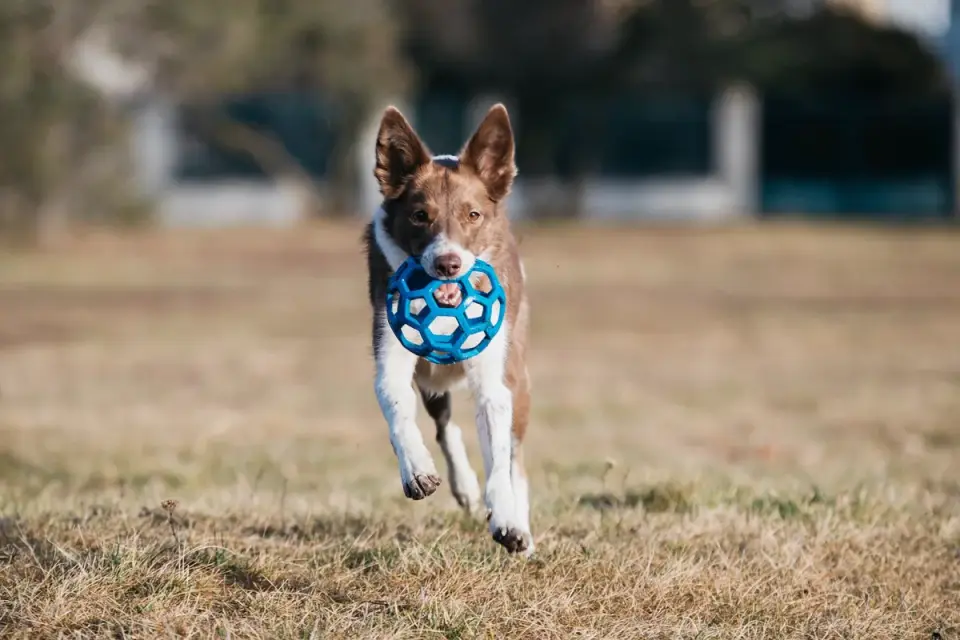
Stopping while the puppy still wants more is the skill.
What a week that respects joints looks like
Think in sessions, not miles. Most large-breed puppies between 4 and 12 months do well with two to three short outings a day, 10 to 25 minutes of active movement each, on forgiving footing, with full rest days built in.
A practical template:
Two leash walks with sniffing and two minutes of basic training. One free-play or explore session on grass or trail. One body-awareness session: cavaletti poles, slow hill walking, sit-to-stand repetitions, wobble-board work if taught calmly. One longer weekend explore where time on feet is long but intensity stays low, with water and shade breaks.
Avoid forced running alongside bikes, extended treadmill trotting, and repetitive stairs as conditioning. The comparison in Dog Treadmill vs Outdoor Walking: What Actually Serves the Dog is useful context here: belts add repetition without the turns, textures, and self-pacing that protect a young joint. Apartment owners can borrow the space-saving ideas in Making Apartment Life Work With a Large-Breed Dog and split movement into smaller blocks rather than one exhausting outing.
Keep body condition lean. Ribs easily felt, visible waist from above, abdominal tuck from the side. Extra pounds multiply joint load far more than any supplement offsets.
Where joint nutrition fits, honestly weighed
This is where I part from both camps. One side says joint supplements protect puppies through hard exercise. The other says they do nothing at all. The evidence is narrower and more useful than either claim.
Chondroitin has peer-reviewed work showing it “supports healthy synovial fluid homeostasis” as reported in Frontiers in Veterinary Science, which matters because synovial fluid is the joint’s lubricant and nutrient bath. Glucosamine HCl has laboratory work showing it “prevent experimentally induced cartilage degradation in vitro” according to Journal of Veterinary Medical Science, which is mechanistic support, not proof it prevents dysplasia or injury in a running puppy. Green-lipped mussel research, summarized in Nutrients, found that “BMO, GMO, and KO all alleviated paw swelling in rats and reduced serum levels of rheumatoid factor (RF), anti-cyclic citrullinated peptide (anti-CCP) antibody, and pro-inflammatory cytokines such as TNF-α and IL-17.”
Read plainly: these ingredients may help support normal joint metabolism and recovery nutrition, but they do not make growth plates run-ready sooner.
My recommendation reflects that boundary. Feed a complete large-breed puppy diet with controlled calcium and steady growth, keep omega-3s adequate through diet, and if you use glucosamine, chondroitin, or green-lipped mussel, treat them as long-term dietary support for mobility alongside training and weight control. The strongest counterargument is fair: why spend money without clinical proof of injury prevention in puppies. I land here anyway because the safety profile in a balanced diet is generally reasonable, the mechanistic rationale is coherent, and what we are supporting is daily tissue nutrition, not permission to add miles.
The sore puppy check that changes the plan
At 11 months and 92 pounds, a mastiff-type puppy came back to training after a weekend hike that ran 90 minutes longer than planned. By day 10 after that hike, the owner noticed the tell I teach every large-breed family: slow to rise after rest, reluctant to load into the SUV, sitting sideways with one hip rolled out.
We did not push through. We cut forced exercise to leash potty walks for five days, kept mental work, checked nails and feet, confirmed appetite and attitude stayed normal, and called the veterinarian when stiffness lasted past 48 hours rather than fading. That edge case matters because large-breed soreness often looks like laziness. A puppy who lies down mid-walk, shortens stride behind, drags on the return leg, or needs longer warm-ups is asking for a deload week, a surface change, and a vet check if lameness, swelling, or persistent stiffness appears.
Return with the 50-percent rule: half the prior volume, varied surfaces, stop before fatigue, then add roughly 10 percent per week if movement stays clean.
Puppies do not need to be tired. They need to be coordinated, lean, and eager to move again tomorrow.
Frequently asked questions
How much exercise can a large-breed puppy have per day?
Think in short sessions rather than a daily mileage target. Two to three outings of 10 to 25 minutes of active, self-paced movement on soft footing, plus training and sniff work, suits most puppies under 12 months. Add volume only if the puppy rises easily after rest and moves symmetrically.
Is running or fetch bad for large-breed puppies?
Forced, repetitive running is the concern, not occasional bursts. Short free play with turns the puppy chooses is lower risk than 30 minutes of straight-line fetch, road jogging, or biking. Avoid downhill fetch, slick floors at speed, and exercise to exhaustion.
Should large-breed puppies take joint supplements?
Diet matters more. A complete large-breed puppy food, lean body condition, and controlled growth do the heavy work. Glucosamine, chondroitin, and green-lipped mussel may help support normal joint nutrition, but they do not prevent injury or allow harder exercise.
Sources
- Frontiers in Veterinary Science 2026 Chondroitin Study — Frontiers in Veterinary Science
- Glucosamine Cartilage Study — Journal of Veterinary Medical Science
- Marine Oil Joint Inflammation Study — Nutrients