Shih Tzu vs Lhasa Apso: How to Tell Them Apart and Which One Ages Better
Shih Tzu and Lhasa Apso share ancient Tibetan roots, but one has a flatter face and a different set of aging risks than the other.
On this page
A woman brought in two dogs on the same afternoon a few years back — a nine-year-old Shih Tzu with a wheeze she’d had “forever” and a twelve-year-old Lhasa Apso whose back legs had started to look a little stiff after naps. She’d always assumed the two breeds were basically the same dog in a different coat color. They aren’t. By the time I’d finished both exams, I’d used two different words to describe what I was watching for — one was airway, the other was spine and knees — and that’s really the heart of this comparison. Shih Tzu and Lhasa Apso descend from the same corner of the world and can look confusingly alike at a glance, but their skulls, their backs, and the way they age are not the same animal wearing two haircuts.
Same region, two different jobs
Both breeds trace back to Tibet. The American Lhasa Apso Club documents a lineage stretching back as far as 800 B.C., where the Lhasa worked as a household sentinel inside monasteries and noble homes near the city of Lhasa — a watchdog by temperament, alert to sound, historically not bred to be handled by strangers. The Shih Tzu’s story runs through the Chinese imperial court instead. According to the American Kennel Club, the modern Shih Tzu likely descends from Lhasa-type dogs brought into the Forbidden City in the 16th and 17th centuries and then bred with Pekingese, which is exactly why the Shih Tzu ended up with the shorter muzzle and flatter face the Pekingese contributed. That single crossbreeding decision, centuries ago, is the root of most of what separates the two breeds’ health pictures today.
The AKC recognized the Lhasa Apso in 1935 — originally, oddly, in the Terrier Group, before it moved to Non-Sporting in 1956. The Shih Tzu didn’t enter the AKC stud book until 1969. Both are companion dogs now, but the Lhasa still tends to run more reserved with strangers and more vocal as a watchdog, while the Shih Tzu, bred purely for palace companionship, tends to be the more universally friendly, lap-first temperament of the two.
The face is the tell, and the face is the risk
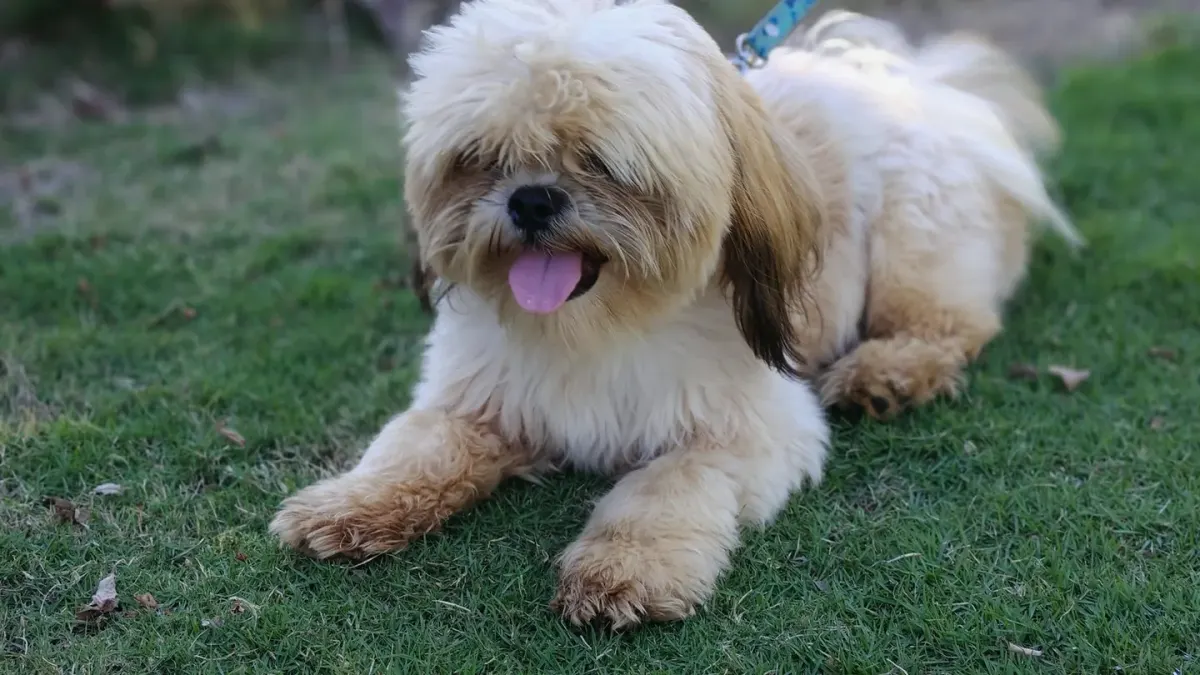
If you only remember one physical difference, make it this: the Shih Tzu has a shorter, flatter face than the Lhasa Apso, whose muzzle is longer and less compressed. That’s not a cosmetic detail — it’s a structure/function issue. The Shih Tzu is one of the more extreme brachycephalic breeds, and per a review from the UFAW, the breed commonly shows narrowed nostrils, an oversized soft palate relative to head shape, and a narrowed windpipe — the anatomical basis of brachycephalic airway obstruction syndrome. In my own exam room, this is the dog whose owner says “he’s always snored” or “he can’t really do stairs in summer,” and both of those are airway signs, not just personality.
The Lhasa Apso, with a proportionally longer muzzle, largely avoids that specific problem. Its risk profile leans toward the eyes and the joints instead — hereditary conditions like progressive retinal atrophy, a slow retinal breakdown that starts as night blindness, according to information compiled by iHeartDogs.com: iHeartDogs, along with patellar luxation, where the kneecap slips out of its groove and produces a skip-step or hop in the back leg. The Shih Tzu isn’t immune to knee or eye issues either — brachycephalic ocular syndrome, distichiasis, and entropion show up regularly in the breed too, and patella luxation and Legg-Perthes disease are both documented orthopedic concerns.
What I actually watch for at different ages

I’ve watched this play out with enough Shih Tzu owners that I now ask about it before they bring it up: does the dog struggle more in July than January, does he flop down after a short walk rather than pant it out, does he snort or reverse-sneeze more when excited. Those are early airway questions, and they matter more in a Shih Tzu than almost any other small breed on my schedule. With Lhasa Apso owners, my questions run differently — I’m asking about night vision (does she bump into furniture after dark before she does in daylight), and I’m watching her walk across the exam room floor for that little hitch in a back leg that owners often describe as “she skips sometimes, then she’s fine.” Neither pattern means the dog is in crisis. Both mean I want a recheck timeline, not a one-and-done visit.
For coat care, the two breeds are nearly identical in workload — both carry a long, dense double coat that mats without regular brushing, and both are commonly clipped short by pet owners who don’t want the maintenance of a full show coat. Neither breed sheds heavily, which is part of why both get recommended to allergy-sensitive households, though no breed is truly non-allergenic.
Building a longevity plan around each breed’s actual weak point
A Shih Tzu’s preventive plan should center on airway and weight management — extra body weight makes any brachycephalic airway problem measurably harder to manage, and heat and exercise intolerance are early warning signs worth logging, not ignoring. A Lhasa Apso’s plan should weight joint support and periodic eye screening more heavily, especially once the dog crosses into the senior years where patellar luxation and early retinal changes tend to surface. In both breeds, joint-support ingredients are commonly used as part of a broader structure/function approach to aging joints, and our guide to the best joint supplements for senior dogs walks through what the evidence actually supports versus what’s marketing. If a dog is already on a joint chew, owners sometimes ask about food-topper tricks — our piece on whether you can crush a longevity chew and sprinkle it on senior dog food covers when that’s reasonable and when it isn’t.
Diet questions come up with both breeds too, particularly around fiber and stool consistency in small dogs with sensitive digestion — see our explainer on whether a dog can have too much fiber if you’re troubleshooting loose stool on a new food. And if you’re evaluating any joint or calming supplement for either breed, it’s worth understanding what the certifications on the label actually mean — our comparison of cGMP certification versus NASC membership breaks down which one verifies manufacturing practice and which one verifies something closer to labeling honesty.
So which one is the better fit
I don’t think there’s a universally right answer here, and I’d distrust anyone who gives you one without asking about your household first. One of the last Lhasa Apsos I worked with was a fourteen-year-old who’d slowed down gradually over about eighteen months — slower on stairs, sleeping later into the morning, but still alert to every doorbell — and her owner’s biggest adjustment was just building in more recovery time between walks, not a medical crisis. A Shih Tzu of the same age, by contrast, is usually the dog I’m watching most closely for exercise tolerance and airway noise, especially in warm weather. If you want a slightly more independent, watchdog-leaning temperament and you’re comfortable monitoring joints and eyes as the dog ages, the Lhasa Apso is the steadier long-term bet structurally. If you want the more classically affectionate lap dog and you’re prepared to manage weight and heat exposure carefully for airway health, the Shih Tzu earns its popularity honestly. Which tradeoff sounds more like something you’d actually manage well for the next decade?
Sources
- Breed History — American Lhasa Apso Club
- Lhasa Apso vs. Shih Tzu: Similarities and Differences — American Kennel Club
- Shih Tzu - Brachycephalic Airway Obstruction Syndrome (BAOS) — UFAW
- Know the Signs: 5 Most Common Health Issues in Lhasa Apsos — iHeartDogs.com