Wire Crate vs. Covered Crate for a Dog With Anxiety: Which One Actually Helps It Settle?
Medically reviewed by Don Thompson, DVM, CVA, CVCH, FAAVA — For general education — not a substitute for veterinary care.
For a dog with anxiety, a covered crate usually settles them faster than an open wire crate, but not always.

On this page
- The Wire Crate’s Case: Airflow, Sightlines, and What It Costs
- The Covered Crate’s Case: Fewer Triggers, One Real Risk
- The Panic Trap Nobody Warns You About
- Matching the Crate to the Anxiety Type
- What Actually Helps the Nervous System, Not Just the Room
- Building the Routine Around the Crate
- What I’d Actually Recommend
I still remember the intake form for an eleven-month-old Australian Shepherd mix named Juniper — thirty-eight pounds, rescued at seven months, crated at night in a standard wire kennel in the laundry room. The owner’s note said Juniper paced for twenty minutes after lights-out, then settled into shallow, interrupted sleep. Nothing dramatic. No destruction, no barking complaints from neighbors. Just a dog who never seemed to fully let go. We tried a simple change first: a breathable cover over three sides of the wire crate, open front only. Within four nights, the owner reported Juniper was lying down within five minutes instead of pacing. That’s one case, not a rule — but it’s the kind of shift I’ve watched often enough to take seriously.
The honest answer to wire versus covered isn’t universal. It depends on what kind of anxious your dog actually is, and that distinction gets lost in most crate-buying advice.
The Wire Crate’s Case: Airflow, Sightlines, and What It Costs
Wire crates exist for good reasons. They breathe well, which matters in warm climates or for double-coated breeds. You can see your dog at a glance, which matters for a puppy you’re still house-training or a senior dog you’re monitoring. And a wire crate never traps heat or odor the way a fully enclosed one can.
For an anxious dog, though, that open visibility is a double-edged design choice. A dog who startles at movement, at another pet walking past, at headlights sweeping the wall — that dog is getting a steady stream of low-grade visual triggers all night, every night. It’s not that wire crates cause anxiety. It’s that they don’t do anything to buffer it, and for some dogs, buffering the environment is most of the job.
The Covered Crate’s Case: Fewer Triggers, One Real Risk
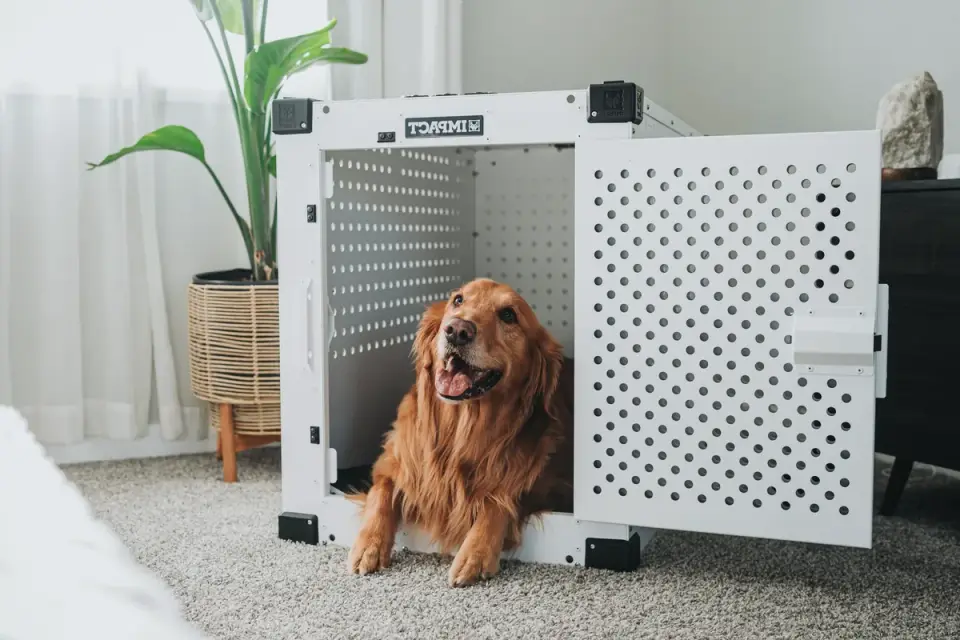
A covered crate — canvas, blanket, or a purpose-built cover — turns the same wire frame into something closer to a den: dim, enclosed, one direction of exposure. For dogs whose anxiety is triggered by seeing things — passing shadows, a housemate’s movement, the fireworks flash outside a window — cutting that visual input often reduces the pacing and the whining within days, not weeks.
But covered isn’t automatically better, and this is where I part ways with blanket advice to “just cover the crate.” A dog whose anxiety centers on confinement or separation, rather than visual stimulation, can read a covered crate as a trap rather than a den. I’ve seen dogs escalate — scratching at the door seam, drooling heavily, refusing to enter at all — the moment a cover went on. For that dog, the cover doesn’t calm anything; it removes the one thing keeping them oriented, which is being able to see the room and the door.
The Panic Trap Nobody Warns You About
This is the case that changes how I counsel owners now. A client brought in a four-year-old Cavalier King Charles Spaniel, roughly eighteen pounds, with a history of true separation anxiety — not mild boredom-barking, but full-blown panic when left alone. The owner, following generic advice, had switched from a wire crate to a fully covered one, reasoning that “den-like” would feel safer. Within two weeks the dog had bent two wires on the crate door trying to get out, and had gone from occasional whining to sustained, escalating distress calls captured on the owner’s camera. Uncovering the crate and leaving the door-facing panel open dropped that intensity noticeably within the same week. The lesson wasn’t that covered crates are bad. It was that a covered crate on top of separation anxiety, specifically, can turn a coping space into a confinement trigger.
Matching the Crate to the Anxiety Type
Here’s the practical filter I actually use with owners:
If your dog reacts to what it sees — passing people, other pets, headlights, storms visible through a window — a covered crate, or even a partial cover on three sides, is usually worth trying first. If your dog’s anxiety centers on being left or being confined at all, start uncovered, with the door-facing side open, and only add partial covering once you’ve confirmed the dog isn’t escalating.
Either way, crate choice is a management tool, not a treatment. It changes the dog’s immediate environment; it doesn’t change the underlying stress response. That’s a distinction worth sitting with before you buy anything.
What Actually Helps the Nervous System, Not Just the Room
A crate — wire, covered, or somewhere in between — controls the environment. It doesn’t touch the biology of a dog that startles easily or can’t settle even in a quiet, dim space. That’s a separate piece, and it’s where I tend to bring up Boops Pets Calming & Stress Relief chews with owners who’ve already tried the crate adjustments and are still watching a dog that won’t fully rest.
The formula pairs KSM-66 Ashwagandha with L-Theanine, L-Tryptophan, Valerian Root, and Chamomile. None of these are sedatives, and I don’t present them that way to owners. A systematic review published in Cureus analyzed multiple randomized controlled trials and found ashwagandha has a moderate positive impact on stress reduction — evidence built in humans, worth noting honestly rather than overselling for dogs. L-theanine has a longer research trail; a review in Molecular Psychiatry found a measurable effect on anxiety symptoms in one study using 400 mg/day over eight weeks, though most other trials in that review didn’t reach the same threshold. Chamomile’s evidence base is thinner still — a review in Biomedicines notes that for most species, including dogs, the evidence is derived mainly from preclinical studies or traditional use, not large controlled trials. I say that plainly because owners deserve the real evidence tier, not a rounded-up version of it.
These statements have not been evaluated by the FDA. This product is not intended to diagnose, treat, cure, or prevent any disease.
Boops Pets is a NASC Quality Seal member, which means its facilities are independently audited under the National Animal Supplement Council’s program — a real, verifiable quality marker, though not a claim about how any individual dog will respond.
Building the Routine Around the Crate
The crate and the chew both matter less than the routine wrapped around them. I ask owners to give a calming chew roughly thirty to sixty minutes before the trigger — the storm, the door, bedtime — and to pair it with the same low-key wind-down sequence every time: lights dimmed, same cue phrase, same location. Our guide on dog calming chews walks through how that timing shifts by life stage, since a startled puppy and an anxious senior aren’t solving the same problem. If your dog’s anxiety is more situational — car rides, vet visits, thunderstorms specifically — it’s also worth reading how chamomile and L-tryptophan compare for that narrower use case, since the two actives don’t do quite the same job.
Not every anxious dog needs an oral calming aid at all. For dogs whose anxiety is mostly about touch and pressure rather than triggers they can see or hear, a wearable option can outperform anything you feed them; we’ve laid out that comparison in Thundershirt versus an oral calming aid for owners trying to figure out which category their dog actually needs.
What I’d Actually Recommend
If I had to give one dog the crate and one dog the chew and send them home, here’s where I land: try the crate adjustment first, because it’s free and reversible within a night or two. Cover it for visually-triggered dogs, leave it open for confinement- or separation-anxious dogs, and watch for four or five nights before deciding it worked or didn’t. Layer the calming chew on top once you know which direction the crate change pushed things, not before — otherwise you won’t know which variable actually helped.
Juniper’s owner never needed the chew; the partial cover did the job on its own. The Cavalier’s owner needed both — an uncovered, open crate and, eventually, a calming chew for the nights that stayed hard regardless. Most dogs land somewhere between those two stories. What does yours look like on a night you haven’t tried adjusting anything yet?
Frequently asked questions
Should I cover a wire crate for a dog with separation anxiety?
Not automatically. Dogs whose anxiety centers on being left alone or confined can find a fully covered crate more distressing, not less. Start with the crate uncovered and the door-facing panel open, and only add partial covering if the dog isn't showing signs of escalation like scratching at the door or excess drooling.
How long should I try a crate change before deciding it isn't working?
Give any single change — covering, uncovering, or repositioning the crate — four to five consecutive nights before judging the result. Anxious dogs often need a few nights to adjust to any environmental change, even a helpful one.
Can a calming chew replace crate training for an anxious dog?
No. A calming chew like Boops Pets Calming & Stress Relief is meant to layer onto a consistent routine and the right crate setup, not substitute for either. Structure/function ingredients such as ashwagandha and L-theanine support a calmer response; they don't retrain the underlying anxiety on their own.
Sources
- Ashwagandha for Stress Reduction: A Systematic Review of Randomized Controlled Trials — Cureus
- L-Theanine and Anxiety: A Review of Clinical Evidence — Molecular Psychiatry
- Chamomile and Anxiety & Stress: A Review of the Evidence — Biomedicines
- NASC Primary Supplier Member Listing — Boops Pets — National Animal Supplement Council